Assistant Professor
Public Policy & Administration
University of Hawaiʻi at Mānoa
Janet Jock

ABOUT

Janet Jock
Assistant Professor
Public Policy and Administration
My mixed-methods approach lies in understanding the quality, performance, and impact of nongovernmental and governmental service provision of social programs positing my research at the crossroads of nonprofit and public management, policy analysis, and international development.
I am also interested in how governmental and non-governmental stakeholders engage with service recipients in the decision-making and coordination of public goods provision and the mechanisms behind differential impacts by service provider type and socio-demographic characteristics.


Research
Jock J, Beidelman E.T., Phillips M, Kobayashi LC, Chen X, Tollman S, et al. (2025). Effects of pension eligibility expansion on men’s memory decline and dementia probability: Findings from the HAALSI cohort in rural South Africa, 2014–2021.
Erika T. Beidelman, Rishika Chakraborty, Janet Jock, Chodziwadziwa Whiteson Kabudula, Meredith L. Phillips, Kathleen Kahn, Katherine Eyal, Darina T. Bassil, Lisa Berkman, Lindsay C. Kobayashi, and Molly Rosenberg. 2023. “Impact of the South African Child Support Grant on memory decline and dementia probability in rural and low-income mothers, 2014-2021”
Janet Jock, Erika T. Beidelman, Lindsay C. Kobayashi, Stephen Tollman, Meredith Phillips, Lindsay Kobayashi, Chodziwadziwa Whiteson Kabudula, and Molly Rosenberg. 2023. "The impact of old age pension eligibility on alcohol consumption: Findings from rural South Africa." (Forthcoming). Innovation in Aging
Haeyoon Chang, Janet Jock, Molly Rosenberg, Chihua Li, Tsai-Chin Cho, Thomas A. Gaziano, Lynda Lisabeth, Lindsay Kobayashi. 2023. “The impact of old age pension expansion on blood pressure among older men in rural South Africa.” (Forthcoming). Innovation in Aging.
Chakraborty, R, Kobayashi, L.C, Jock, J, Wing, C, Chen, X, Phillips, M, Berkman, L, Kahn, K, Kabudula, C.W, & Rosenberg, M. 2022. “Child Support Grant Expansion and Mid-to-Later Life Cognitive Function among Women in Rural South Africa: Findings from a Natural Experiment in HAALSI” (Forthcoming). PLOS ONE
Janet Jock, Lindsay C Kobayashi, Rishika Chakraborty, Xiwei Chen, Coady Wing, Lisa Berkman, Chodziwadziwa Whiteson Kabudula, Stephen Tollman, Molly Rosenberg. 2023. “Effects of pension eligibility expansion on men’s cognitive function: findings from rural South Africa” Journal of Aging & Social Policy.
Jennifer Brass, Janet Jock. 2022. “Public Goods Provision and State Legitimacy: Does Provider Type Affect Views of the State in the Global South?” Voluntas: International Journal of Voluntary and Nonprofit Organizations
Baldwin, Elizabeth, Val Rountree, and Janet Jock. 2018 “Distributed Resources and Distributed Governance: Stakeholder Participation in Demand Side Management Governance.” Energy Research & Social Science 39 (May).
Peer-Reviewed Publications
Allison Schnable, Susan Appe and Janet Jock. 2022. “Perpetual Effervescence? The Life Cycles of Citizen Aid Organizations in the U.S.” In The Rise of Small-Scale Development Organisations: Citizen Aid Actors and their Role in Civil Society, edited by Hanne Haaland, Sara Kinsbergen, Lau Schulpen, and Hege Wallevik. Under contract with Routledge Explorations in Development Studies, Routledge Press.
Book Chapter
"Program Impacts and Institutional Arrangements in Nonprofit and Governmental Service Provision: A Practical Application of the Institutional Analysis and Development Framework" with Jude Ugwuoke (R&R at International Journal of Public Administration)
‘Does Non-Profit Organization Membership Improve Well-being Outcomes? An African Cross-country Analysis Exploring Active, Inactive and Multiple Memberships’ with Cheon Lee (Under Review at NVSQ)
“Effects of Civil Society Organization Density on Health Care Access: Evidence from West Africa” with Jude Ugwuoke and Kelly Krawczyk (Under review at Journal of Public and Nonprofit Affairs)
“Exploring Contextual Determinants of the Older Person’s Grant Expenditure and Aging Health: A Qualitative Study among Older Adults in Rural South Africa” with Haeyoon Chang, Lindsay Kobayashi and Stephen Tollman (Submitted to PLOS ONE)
“Who joins? Who Participates? And Who Leads Civil Society Organizations in Developing Countries? Evidence from Eleven Types of CSOs in Kenya” with Jennifer N. Brass, Matthew Baggetta, Alesha Porisky, Lauren M. MacLean, Chrstopher Gore, Winnie Mitullah. (Analysis and draft nearly complete; estimated submission: Dec. 2025)
“Reconceptualizing “localization”: How do community-based organizations adopt the localization approach?” with Lucky Umezulike, Kelly Krawczyk, Peter Weber . (analysis and draft nearly complete; estimated submission: Dec. 2025)
“The Impact of CSO Participation on Health, Education, and Civic Engagement across African Countries” with Jude Ugwuoke and Julius Adinoyi (analysis finished, draft in progress)
“Impacts of USAID Retrenchment on Nonprofit Programs: Evidence from Liberia and Ghana” with Kelly Krawczyk and Peter Weber (survey data collected, analysis in progress)
“Brokers and Fixers: Power Dynamics and Positionality in Social Science Research in the Global South” with Kelly Krawczyk and Peter Weber (in early stages of analysis)
R&R, Under Review and Work in Progress
Research & Collaboration
Wits Research Center - South Africa
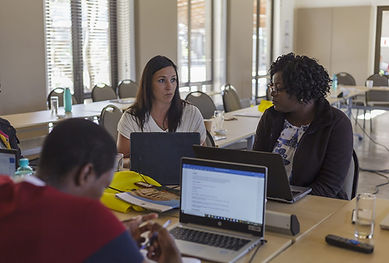
Collaboration with Wits University Researchers

Sharing Analytic Methods
.jpg)
Presentation: Impact of South African Pension Expansions
Grants & Awards

Elements of Participatory Development Driving Program Success
Awarded: $49,836, 2025
PI with co-investigators Kelly Krawczyk and Peter Weber. Auburn University Research Support Program (RSP) Award. Mixed methods design measures the effectiveness of participatory development mechanisms on project outcomes and community engagement.
Summer Merit Scholarship
O’Neill School of Public and Environmental Affairs
Awarded $1,000
2023
U.S. Fulbright
U.S. Fulbright Student Scholarship, South Africa
Alternate - 2023
O’Neill Ostrom Fellowship
Indiana University –Bloomington
Awarded $30,000
2023-2024
Tobias Center for Innovation in International Development
Research Grant:
Funded, $5000, 2023
Funded, $3000, 2022
Funded, $1,200, 2023
O’Neill Graduate Student Teaching Award
O’Neill School of Public and Environmental Affairs
2023
Irsay Institute
Irsay Institute Fellowship
Awarded, $11,000
2023
Teaching and Service Statement
My teaching and service philosophy is grounded in the belief that public administration and nonprofit management education should equip students not only with analytical and technical skills, but also with the cultural awareness, ethical grounding, and collaborative capacity necessary to serve diverse communities effectively. As an educator and scholar, I strive to create learning environments that are inclusive, applied, student-centered, and connected to real-world public service challenges. My experiences working across academic, nonprofit, and international development settings have reinforced my commitment to preparing students to become thoughtful, socially responsible and community-engaged leaders.
My teaching approach emphasizes three core principles: applied learning, collaborative engagement and critical reflection. I believe students learn best when they are actively engaged in connecting theory to practice and when they are encouraged to critically examine how public and nonprofit institutions shape social outcomes for different populations and communities.
Since joining Auburn University as an Assistant Professor and core member of the Master and PhD of Public Administration and Policy faculty in Fall 2024, I have taught graduate level courses including Nonprofit Law and Governance, NGOs and International Development, Civil Society and Democracy in South Africa, Research Methods and Foundations of Public Administration. These courses integrate theoretical foundations with practical case studies, policy analysis, collaborative projects, and experiential and service-learning opportunities designed to prepare students for careers in public and nonprofit leadership.
One of the most meaningful teaching experiences I have developed is the Civil Society and Democracy in South Africa course which included a study abroad component. In this course, students examine the historical and contemporary role of civil society organizations in governance, reconciliation, and development before traveling to South Africa to engage directly with nonprofit leaders, community organizations, academics, and public officials. Through these experiences, students gain a deeper understanding of participatory governance, inequality, and community-centered approaches to public problem solving. I believe these forms of immersive and reflective learning help students connect classroom concepts to the realities of governance and nonprofit management in diverse cultural contexts.
Additionally, my Nonprofit Law and Governance course incorporates a substantial service-learning component that connects students directly with nonprofit organizations in the community. Students identify and partner with nonprofit organizations throughout the semester, conducting board analyses and nonprofit audit projects designed to assess organizational governance, capacity, and operational needs. Based on their findings, students develop practical materials and recommendations tailored to the organization’s identified needs and present their work both to the nonprofit partners and to their fellow students at the end of the semester. This experiential approach allows students to apply classroom concepts to real organizational challenges while building collaborative relationships with nonprofit practitioners.
In the classroom, I prioritize creating an environment where students feel comfortable contributing their perspectives and learning from one another. I use group work, discussion-based learning, case studies, policy simulations, and applied assignments to encourage participation and strengthen practical skills in leadership, communication, teamwork, and problem-solving. My teaching is also informed by my professional and international experiences outside academia. Prior to my academic career, I served as a Peace Corps volunteer in Colombia and Nicaragua, worked as an international educator in South Korea and Turkey, and served as a campaign office director across several different locations in the United States. These experiences strengthened my commitment to culturally responsive teaching and reinforced the importance of listening to communities, understanding local contexts, and valuing diverse perspectives in public service work.
Beyond the classroom, I actively contribute to Auburn University’s graduate program by serving on five PhD dissertation committees, including three as co-chair, and regularly participating in PhD Brown Bag sessions. I also developed and organized a professional speaker series that brings nonprofit and public service leaders to the university to engage graduate students in discussions about leadership, governance, community engagement, and contemporary challenges facing the public and nonprofit sectors. This year, I helped develop Auburn’s online MPA program by designing two core graduate courses (Foundations of Public Administration and Quantitative Research Methods), including course design, recorded lectures, assignments, and interactive discussion activities. Additionally, I have served as faculty for Auburn’s Center for Election Administration Certification Program, teaching election administrators from across the United States in both online and in-person settings. This work reflects my broader commitment to strengthening democratic governance and public institutions through applied education and professional engagement.
My research and service activities are deeply connected through collaborative community-engaged work. As a member of Auburn’s Global Development Solutions Research Lab, I collaborate with faculty, PhD and Masters students to examine the role of nonprofit and civil society organizations in health, education, governance, and participatory development initiatives across international contexts. We have just returned from piloting a Girls Empowerment and Civic Engagement Workshop which will be implemented this fall in Liberia and I will travel to Indonesia this summer to work with a nonprofit organization to implement a similar program. These faculty-student collaborations have reinforced our contribution to research that helps communities support practical problem solving.

Teaching Experience
Auburn University
Auburn University Graduate Level Courses:
-
Research Methods for Public and Nonprofit Organizations (MPA) Spring ’25-26
-
Spring 2026 NGOs and International Development (MPA & PhD)
-
Civil Society and Democracy: South Africa (MPA & PhD) Spring 2025
-
Nonprofit Law and Governance (MPA)
-
Foundations of Public Administration and Service (MPA)
Indiana University, Associate Instructor
U.S. Policy and Administration, Spring & Fall 2022, Spring 2023
This course introduces the policy-making and implementation process in the United States and highlights the forces that have shaped some of the most salient policy battles of the last decade. Using hands-on activities, active discussions, and professional tools, this course gives students the knowledge, skills, and perspectives needed to see public policymaking and administration in a more comprehensive way and to start thinking about how to shape new policies.
Indiana University, Co-Instructor
Statistical Techniques, Fall 2021
This course introduces basic statistical analysis and interpretation. Topics covered in this course include (but are not limited to) the following: the nature of statistical data, ordering and manipulation of data, measures of central tendency, probability, statistical inferences, hypothesis testing, estimation, and correlation and regression. The focus of this course is on the practical application and interpretation of statistics for intelligent functioning in a professional or academic environment. As such, the course simulates the real environment as much as possible, comprised of peers and resources to aid in statistical application and interpretation. While it is necessary to demonstrate individual mastery of the key concepts taught in this course, it is equally imperative to develop skills and techniques to apply statistical knowledge in a practical setting.
University of Arizona, Teacher’s Assistant
Statistics for the Social Sciences, 2016-2017
An introductory course in the fundamentals of modern statistics with applications and examples in the social and behavioral sciences. Topics include methods for describing and summarizing data, probability, random sampling, estimating population parameters, significance tests, contingency tables, simple linear regression, and correlation.
University of Arizona, Teacher’s Assistant, Introduction to Public Administration, 2015-2016
This course focuses on developing each student’s comprehension of the history and foundational underpinnings of Public Administration. The course will cover the economic, political, and social dynamics within the field of public administration as well as the management challenges related to human resources, finances, program development, evaluation, technology, and strategic planning. In addition, this introduction to Public Administration will consider public service as a personal and professional commitment when considering the ethics and values unique to this sector. Through the use of the textbook, assigned readings, case studies, simulations, and hands-on experiential learning; students will be afforded an opportunity to advance their theoretical and practical knowledge of public administration
Professional and International Experience
Peace Corps, Colombia ESL Teacher Trainer and Curriculum Developer, 2013-2014
Bilfen Koleji International School, Turkey, 2011-2013
Daejeon International School, South Korea, 2010-2011
Grassroots Campaigns, Inc., Campaign Office Director, 2008-2009
Peace Corps, Nicaragua Adolescent and Maternal Health Programs, 2006-2008
Get in Touch
University of Hawaiʻi at Mānoa 2500 Campus Road
Honolulu, HI 96822
413-237-9714
janetjock.com

AFFILIATIONS